
A website audit score
you can explain.
SiteRevive IQ applies explicit rules to captured website inputs. Every point lost connects to a finding, an affected page, a severity, and visible reasoning—so the score can start a useful client conversation instead of ending one.
What “deterministic” means here.
For the same captured inputs and the same scoring rules, SiteRevive IQ produces the same score. That makes the result traceable and repeatable.
It does not mean a live website will always receive the same score. Pages, configurations, third-party services, crawl conditions, and supported rules can change between scans.
Six visible steps.
Crawl the website
Evaluate accessible pages and collect the inputs needed for supported checks.
Apply fixed rules
Compare captured inputs with the scoring rules available for the selected audit.
Record the finding
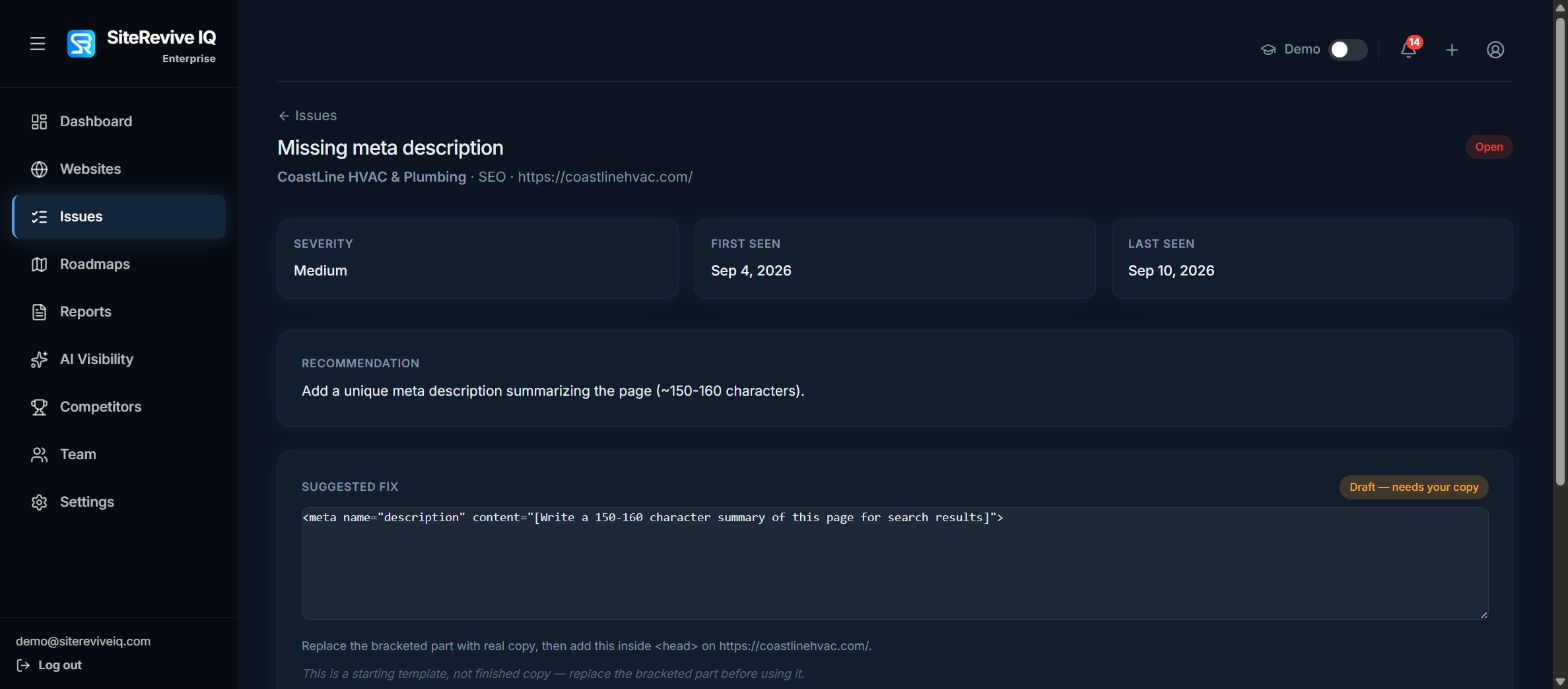
Connect an incomplete or failed check to the affected page and severity.
Explain the deduction
Show what cost points and why the condition matters.
Recommend the next step
Provide practical guidance and code examples where the product supports them.
Rescan and compare
Show resolved and remaining issues against the baseline.
One score needs context.
Crawlable technical conditions evaluated by supported rules.
On-page and technical search signals covered by the audit.
Structural and content signals the system can evaluate consistently.
Detectable conditions, not a penetration test.
Detectable page and journey signals, not behavioral research.
Automated checks that can surface potential barriers, not a conformance determination.
Supported comparison signals that add context, not a complete market strategy.
Basic includes four core categories. Pro includes all seven. The plan pages remain the source of truth for current scope.
What the score can—and cannot—tell you.
It can help answer
- What did the audit detect?
- Which findings deserve attention first?
- What caused the score to change?
- What changed after the work?
It does not prove
Complete accessibility compliance, comprehensive security, legal compliance, search rankings, conversion lift, or business outcomes. Important findings still require expert review in context.
Readiness is not a guarantee.
Structured data, entity clarity, and relevant crawler rules can be inspected. The optional presence of llms.txt can be recorded, but it is not a Google ranking signal.
No readiness check can guarantee rankings, inclusion, or citations in an AI answer.
Clear questions. Direct answers.
Does a higher score guarantee better rankings or more sales?
No. The score reports supported audit conditions. Rankings, conversions, and sales depend on many factors outside an automated website audit.
Can two scans of the same website differ?
Yes. A live website and its dependencies can change. When the captured inputs and scoring rules are the same, the result is repeatable; when either changes, the score may change.
Does the accessibility category prove WCAG conformance?
No. Automated checks can identify some potential barriers. Complete evaluation also requires manual testing, context, and expert judgment.
Does the security category replace a security assessment?
No. It reports detectable conditions covered by the audit. It is not a penetration test or a complete security review.
Walk through a real product demo.
Bring a website and your questions. We will show how findings become priorities, a roadmap, and measurable follow-up.